


Equipment portfolio
PBT Works
Batch cleaning
PBT Works builds automatic batch cleaning systems for electronic assemblies and production tooling. The application determines the machine variant, fixtures, chemistry and rinse-loop configuration.
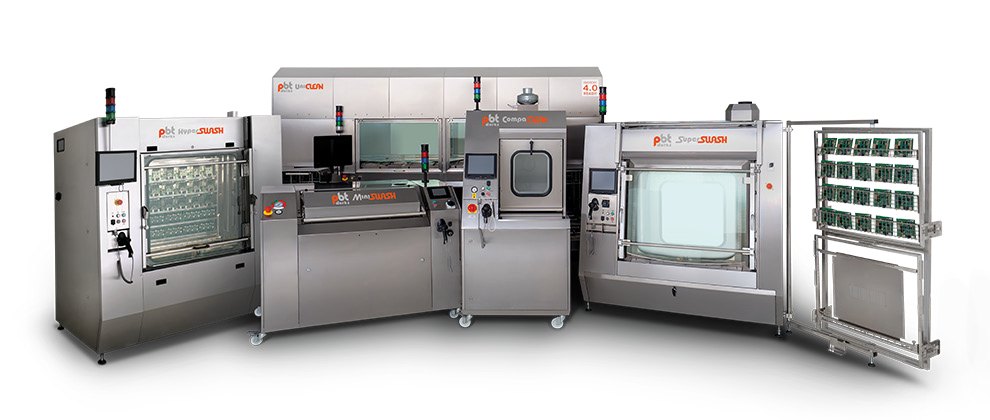
Choose a batch cleaner around residue chemistry, access beneath components, loading density and the cleanliness evidence required by the product. The same family name can cover different cleaning applications and generations.
Solutions
- Batch cleaning systems
PBT Works · 01 / 01
Batch cleaning systems
Batch cleaner.
Compare compact and highly automated batch systems for the required cleanliness, part geometry and production load. Closed-loop rinsing is configuration-dependent; confirm water treatment, chemistry and maintenance-waste requirements separately.
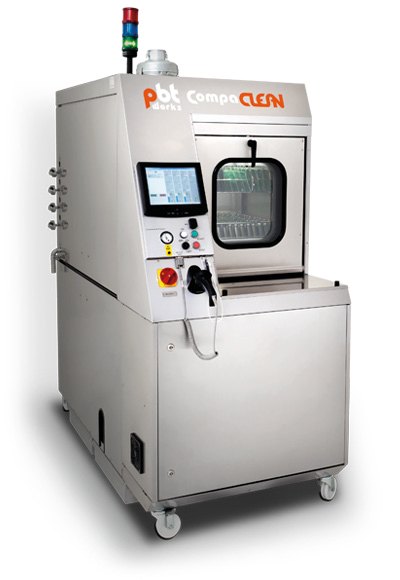
CompaCLEAN
CompaCLEAN family: confirm application and version
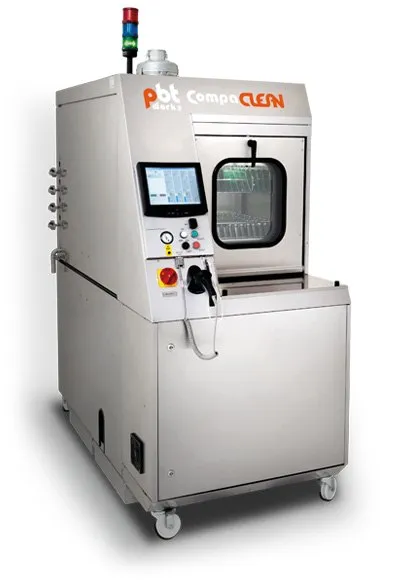
The current CompaCLEAN III PCBA version targets standard SMD assemblies at medium volume with easy-to-moderate residues. It uses oscillating baskets, fixed spray nozzles and convection drying; pallet-cleaning variants are specified separately.
View product online- III PCBA version: standard SMD assemblies, medium volume
- Validate chemistry and residue compatibility with real assemblies
Applications
- Batch-clean standard surface-mount assemblies with light to moderate residues in medium-volume production.
How does the spray reach the boards?
In the CompaCLEAN III PCBA version the baskets oscillate past fixed nozzles. Arrange a trial basket as it will be loaded in production to check coverage.
Can I specify this version for solder pallets?
PBT identifies the III PCBA configuration for populated boards. For pallets, provide their size, weight and flux loading to select the pallet-cleaning version.
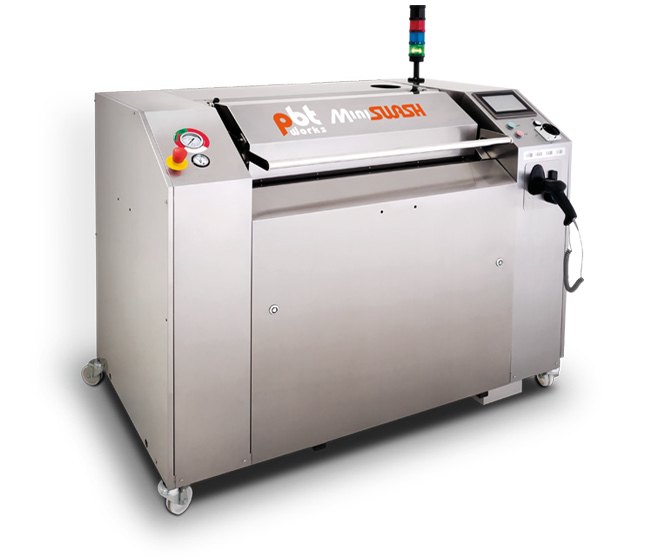
MiniSWASH
Application-specific MiniSWASH versions
MiniSWASH is an application-specific family: the current III PCBA version addresses R&D, prototypes and very low volumes, using rotating sprays and a rotating hot-air knife. Confirm the II stencil version for stencil and misprint tasks.
View product online- III: rotating wash spray and rotating hot-air-knife drying
- Select fixtures and chemistry for the exact application
Applications
- Clean prototype boards and small engineering lots while developing a PCBA cleaning process.
Does MiniSWASH III suit a pilot line?
PBT positions the III PCBA version for development and very low volumes. Check a loaded cycle against the number of boards required per shift.
How is a prototype dried after rinsing?
The PCBA version uses a rotating hot-air knife. Include the tallest components and any shielded pockets on the sample board when checking dryness.
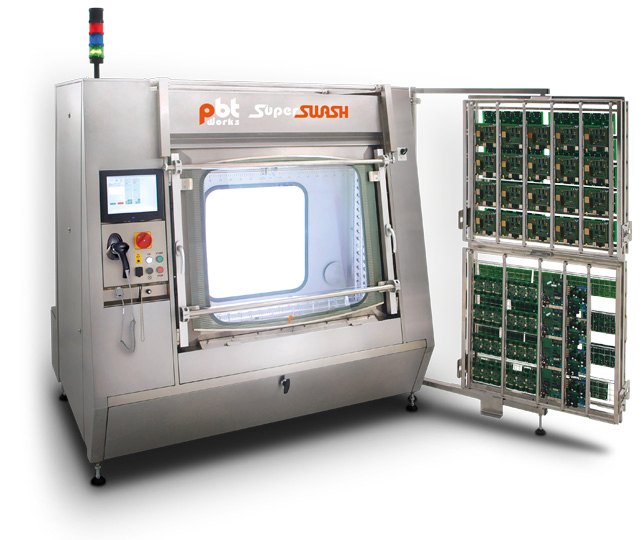
SuperSWASH
SuperSWASH III: direct spray for complex assemblies
The current SuperSWASH III PCBA version focuses on complex, high-density assemblies at low-to-medium volume, with linear spray and hot-air-knife drying. Stencil-cleaning SuperSWASH II has a different application focus.
View product online- III: linear spray and hot-air-knife drying
- Confirm fixture, chemistry and access beneath components
Applications
- Clean densely populated assemblies in small to medium production lots.
Which SuperSWASH is intended for a printing stencil?
PBT documents the SuperSWASH II stencil cleaner separately from the III PCBA cleaner. Specify the stencil frame or populated assembly when requesting a trial.
What should a high-density board trial check?
The III PCBA uses linear spray and hot-air-knife drying. Inspect the least accessible component gaps for residue and retained rinse water after a full cycle.
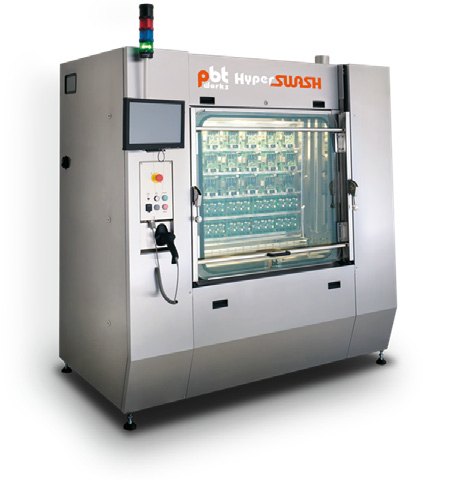
HyperSWASH
HyperSWASH III: configurable handling and automation
HyperSWASH III offers TWINGO and COMBO loading arrangements, buffered pushcart handling and configurable process monitoring. Match automation and cleaning configuration to the assembly.
View product online- Closed wash loops; rinse configuration depends on the process
- TWINGO and COMBO configurations
- Confirm low-standoff access with real assemblies
- TWINGO configuration prioritizes access to demanding assemblies; COMBO prioritizes loading density for suitable products.
- Buffered pushcart handling can be manual or automated; optional monitoring and MES integration require configuration.
Applications
- Process production batches of complex assemblies with cart-based loading.
How do TWINGO and COMBO affect loading?
PBT offers TWINGO for access to demanding assemblies and COMBO for high loading density. Trial the intended basket arrangement to compare cleanliness and boards per cycle.
Can the next load be prepared while a batch is running?
HyperSWASH III supports buffered pushcarts. Specify whether operators or an automated system will handle the carts and reserve staging space at the machine.
Applications across separately configured versions
- PCBA and PCB assemblies
- Stencils and misprints
- Squeegees
- Soldering pallets and production tooling
- Mechanical parts
- Condensate filters
Applications & selection
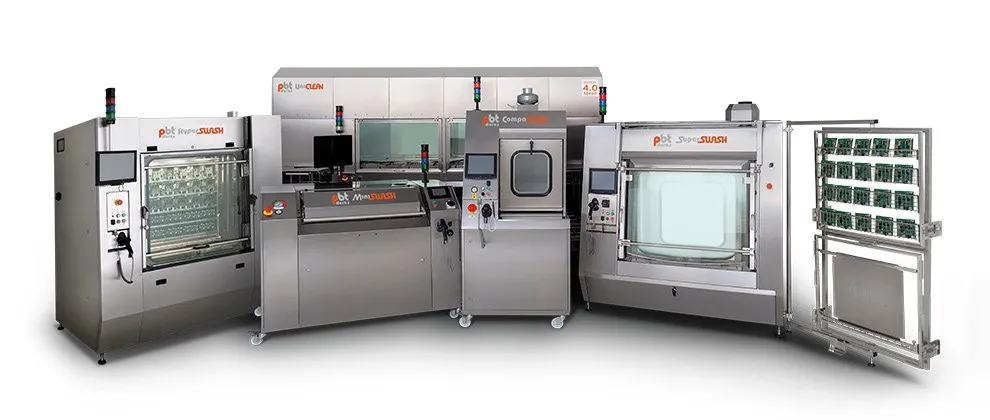
PBT systems combine controlled wash, rinse and drying stages. CompaCLEAN uses oscillating baskets with fixed sprays; SuperSWASH emphasizes direct spray for complex assemblies; HyperSWASH adds configurable handling and automation; MiniSWASH serves smaller-volume tasks.
Where it fits
- PCBA defluxing before coating, bonding or further processing
- Stencil, misprint, pallet and tooling cleaning with the appropriate configuration
What to consider when selecting
- Test the actual flux/cleaner combination and low-standoff geometry; a conductivity result alone does not characterize every residue.
- Calculate batch capacity with the chosen fixture, board height and wash/rinse/dry recipe, including handling time.
- Define rinse-water supply, filtration, chemistry control and waste handling for the actual open- or closed-loop configuration.
Common questions
Does zero-drain mean there is no process waste?
No. Closed loops reduce routine discharge, but used chemistry and filters still need management. Define the rinse and disposal arrangement for the installation.
Which family suits difficult low-standoff assemblies?
SuperSWASH emphasizes direct spray for complex products; HyperSWASH offers TWINGO handling for demanding assemblies and COMBO for loading density. Confirm results with actual samples.
Are stencil and PCBA versions interchangeable?
Do not assume so. PBT lists application-specific versions, such as MiniSWASH II and SuperSWASH II for stencils and III variants for PCBA. Match chemistry, fixtures and process to the exact version.
Documentation & references
Images illustrate products or families; they do not establish the revision or accessories of quoted equipment. Capabilities and options depend on configuration and process conditions. Confirm requirements with an applications engineer.
- PBT cleaning applications and machine variantshttps://www.pbt-works.com/cleaning-systems/
- CompaCLEAN III: PCBA cleaninghttps://www.pbt-works.com/cleaning-systems/pcb-cleaning/compaclean-iii/
- MiniSWASH III: small-volume PCBA cleaninghttps://www.pbt-works.com/cleaning-systems/pcb-cleaning/miniswash-iii/
- SuperSWASH III: direct-spray PCBA cleaninghttps://www.pbt-works.com/cleaning-systems/pcb-cleaning/superswash-iii/
- HyperSWASH III: handling and process configurationshttps://www.pbt-works.com/cleaning-systems/pcb-cleaning/hyperswash-iii-pcb/
- SuperSWASH II: stencil cleaninghttps://www.pbt-works.com/cleaning-systems/stencil-cleaning/superswash-ii/
- PBT cleaning-process qualification and diagnosticshttps://www.pbt-works.com/cleaning-diagnostics/