


Equipment portfolio
Austin American Technology
In-line cleaning systems for electronic assemblies.
Austin American Technology manufactures batch, in-line, solvent and stencil cleaning equipment, along with DI-water recirculation systems. Select the cleaner and water treatment for the residue and production process.
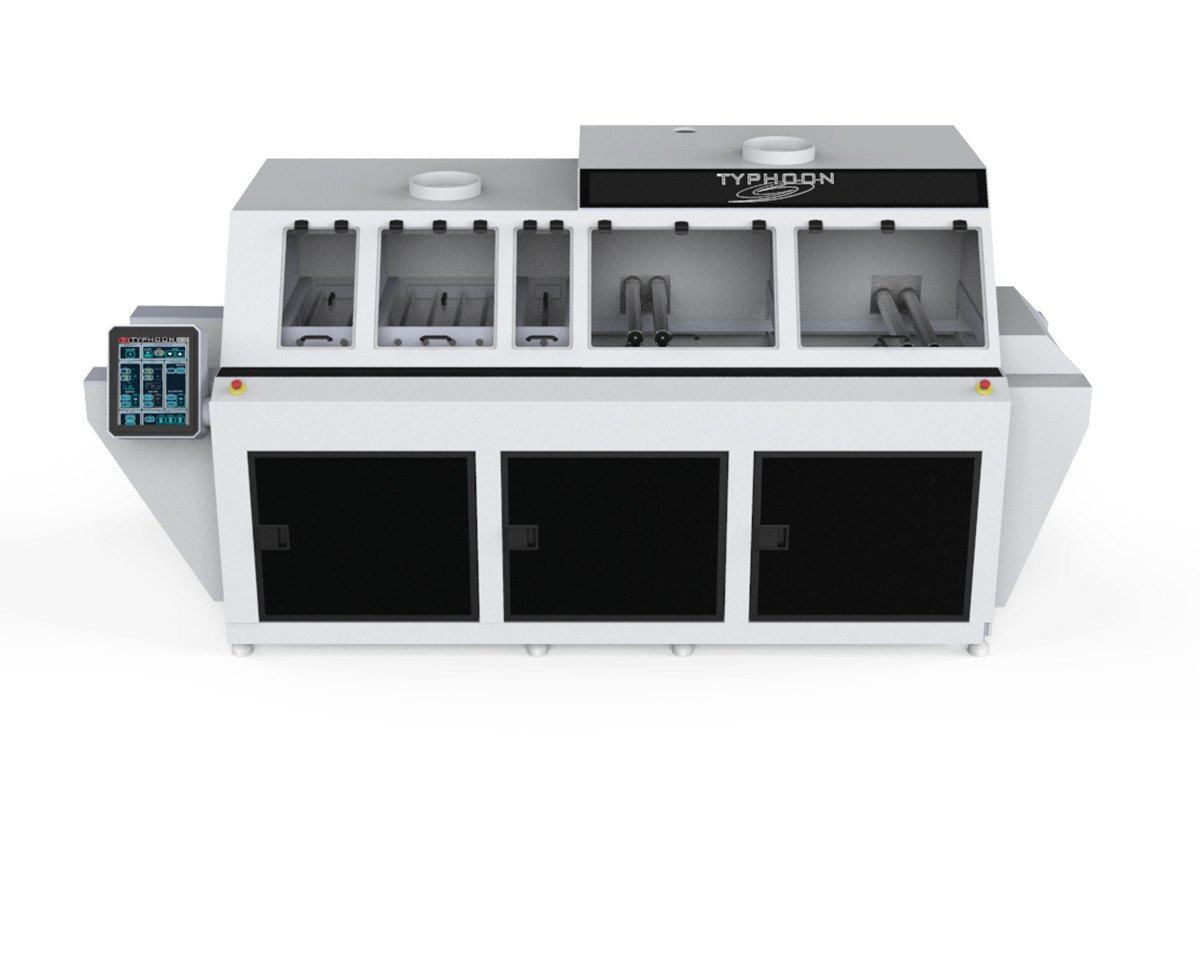
Choose an in-line cleaning process together with its chemistry, rinsing, drying and water-recycling requirements.
Solutions
- In-line cleaning
- DI-water recirculation systems
Austin American Technology · 01 / 02
In-line cleaning
Jet cleaning and displacement drying.
HydroJet, MicroJet EC and NanoJet use jet washing and displacement drying. T8 is a chemical wash/isolation module requiring a separate rinse stage; T12 provides water washing and drying.
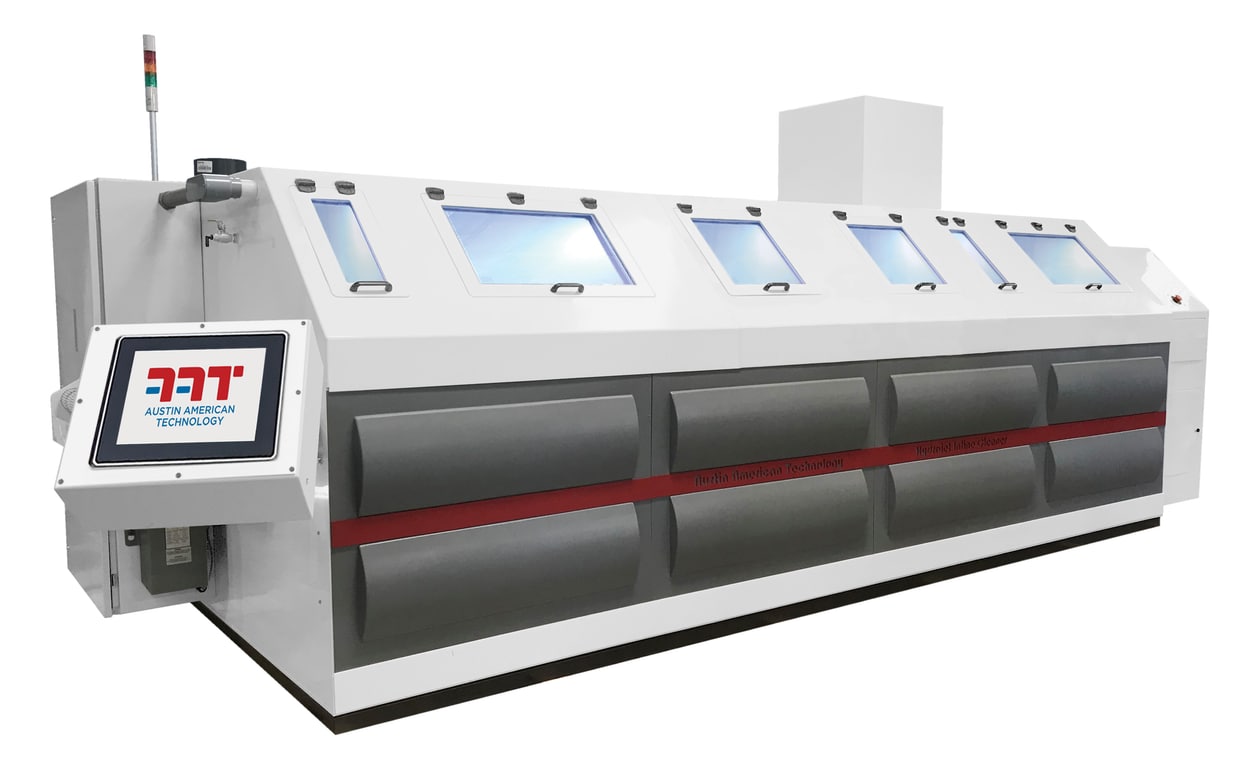
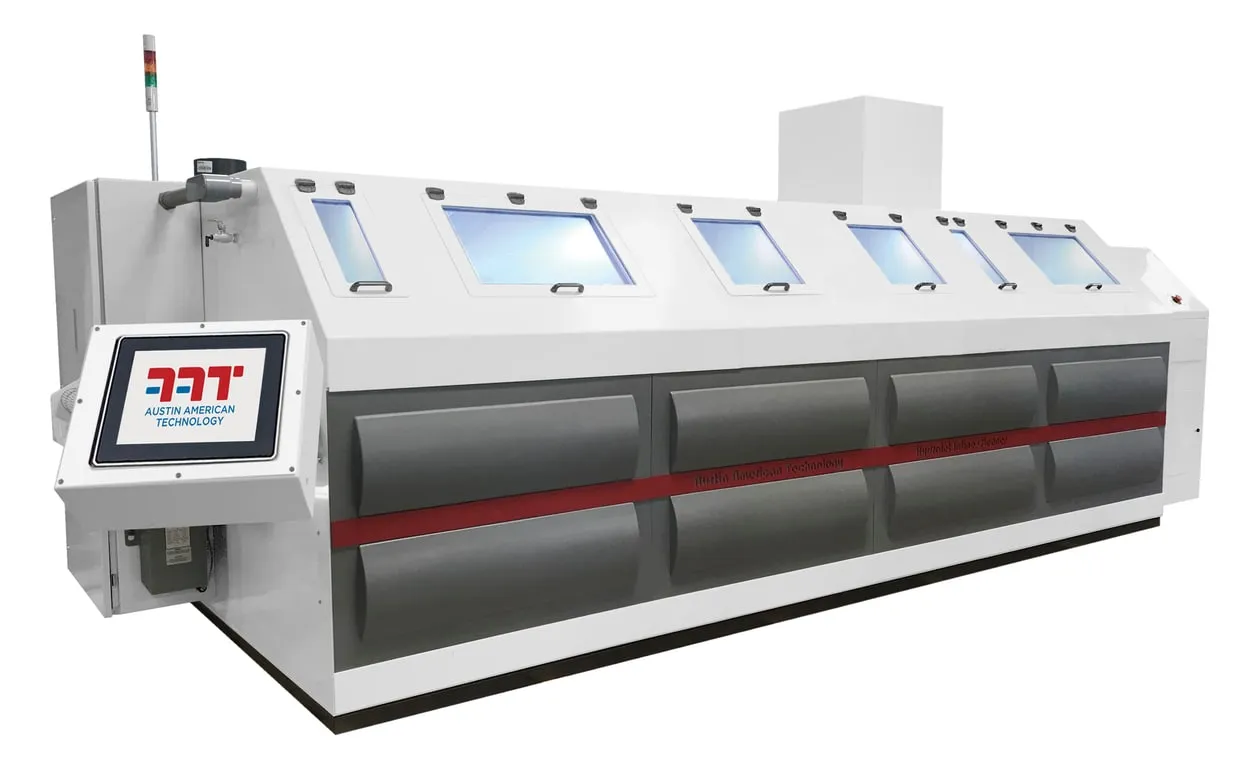
HydroJet®
Water or chemical in-line cleaner
Water or chemical in-line washing with integrated closed-loop DI rinsing, final-rinse resistivity alarm and HEPA-filtered displacement drying.
View product online| Technical information | |
|---|---|
| Conveyor belt | 24 in / 60.96 cm |
| Maximum listed chemical wash temperature | 150 °F / ≈66 °C |
| Maximum listed water rinse temperature | 140 °F / 60 °C |
Applications
- Wash flux residues from populated boards in a continuous conveyor process.
- Monitor final rinse-water quality before boards enter the drying section.
Can HydroJet run a chemical wash?
AAT lists both water and chemical washing. Identify the flux and test a populated board to choose the wash medium and conveyor speed.
What does the final-rinse alarm measure?
It monitors rinse-water resistivity. To accept a finished board, use the cleanliness test specified for that assembly.
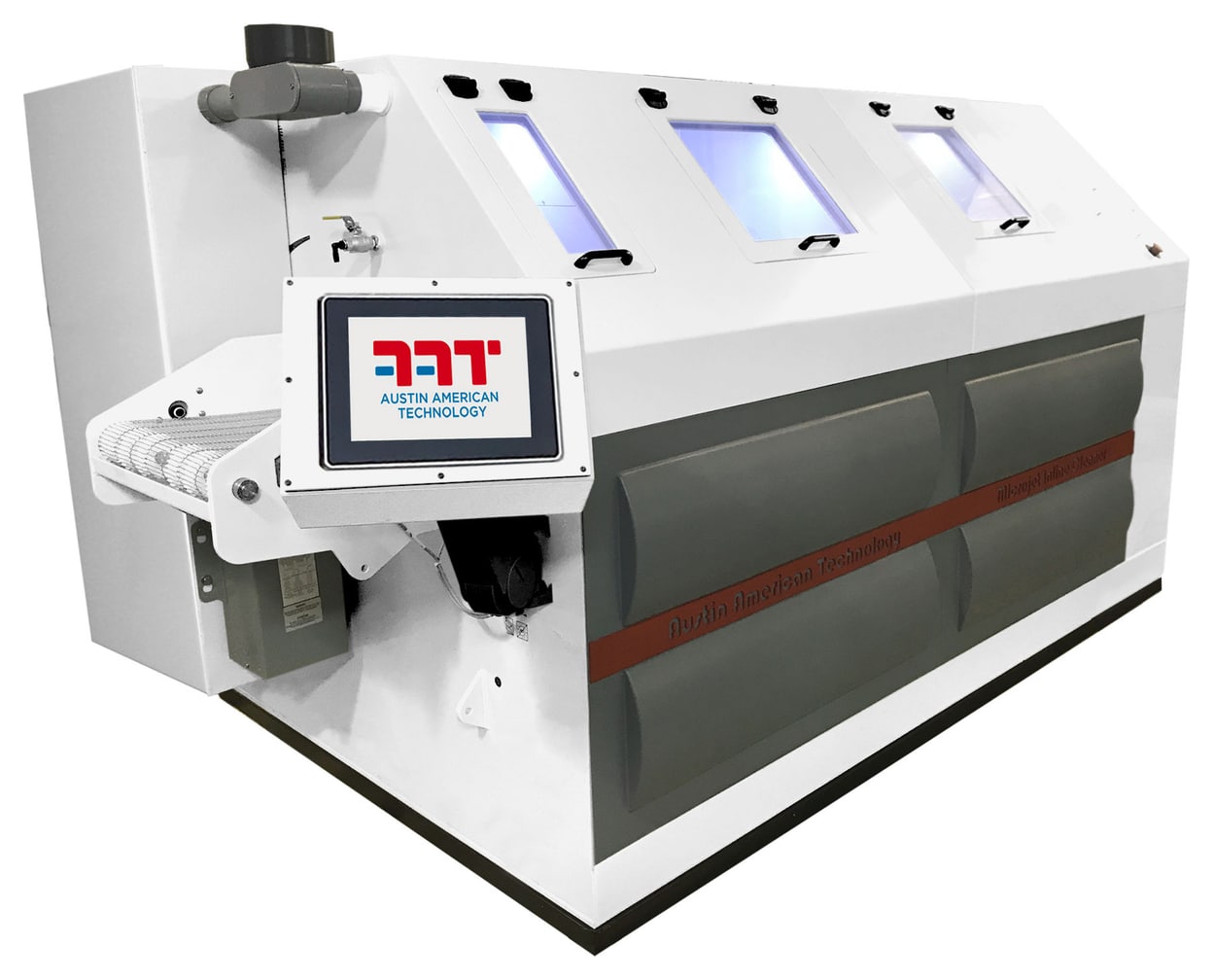
MicroJet® EC
In-line water cleaner
Water-only system combining pre-wash, power wash, final rinse and drying; verify compatibility with the flux residue before selecting this process.
View product online| Technical information | |
|---|---|
| Conveyor belt | 18 in / 45.72 cm |
| Listed belt-speed range | 0.5–4.0 ft/min |
Applications
- Remove water-soluble residues from assemblies on an 18-inch conveyor.
Will the water-only MicroJet EC suit our flux?
Check the flux data sheet for water washability and test a reflowed board. Residues that require a cleaning agent call for a different wash configuration.
What affects board spacing on the belt?
AAT lists a belt speed range of 0.5–4 ft/min. Establish the speed that cleans and dries the board first, then use its length and spacing to calculate throughput.
NanoJet®
High-impact cleaning, high-velocity drying
Compact water/semi-aqueous cleaning with PED spray bars, air-knife isolation and an integrated DI loop.
View product online- Air knives isolate wash and rinse stages. The integrated deionized-water loop filters and returns process water.
| Technical information | |
|---|---|
| Conveyor belt | 12 in / 30.48 cm |
| Listed belt-speed range | 0.5–3.0 ft/min |
| Datasheet electrical supply | 480 V, 50/60 Hz, 100 A, 3Φ |
| Published dimensions (L × W × H) | 8 ft × 3 ft 8 in × 4 ft 2 in |
| Machine mass | 2,500 lb / ≈1,134 kg |
Applications
- Clean compact assemblies in line where the board or carrier fits the 12-inch belt.
What should I measure if I use a carrier?
Measure the loaded carrier, including its guides and any overhang. The model sheet lists a 12-inch conveyor. Confirm usable clearance with the actual tooling.
How are the wash and rinse zones separated?
NanoJet uses air knives for isolation and an integrated deionized-water loop. Check for trapped wash liquid in connectors and fixtures during the board trial.
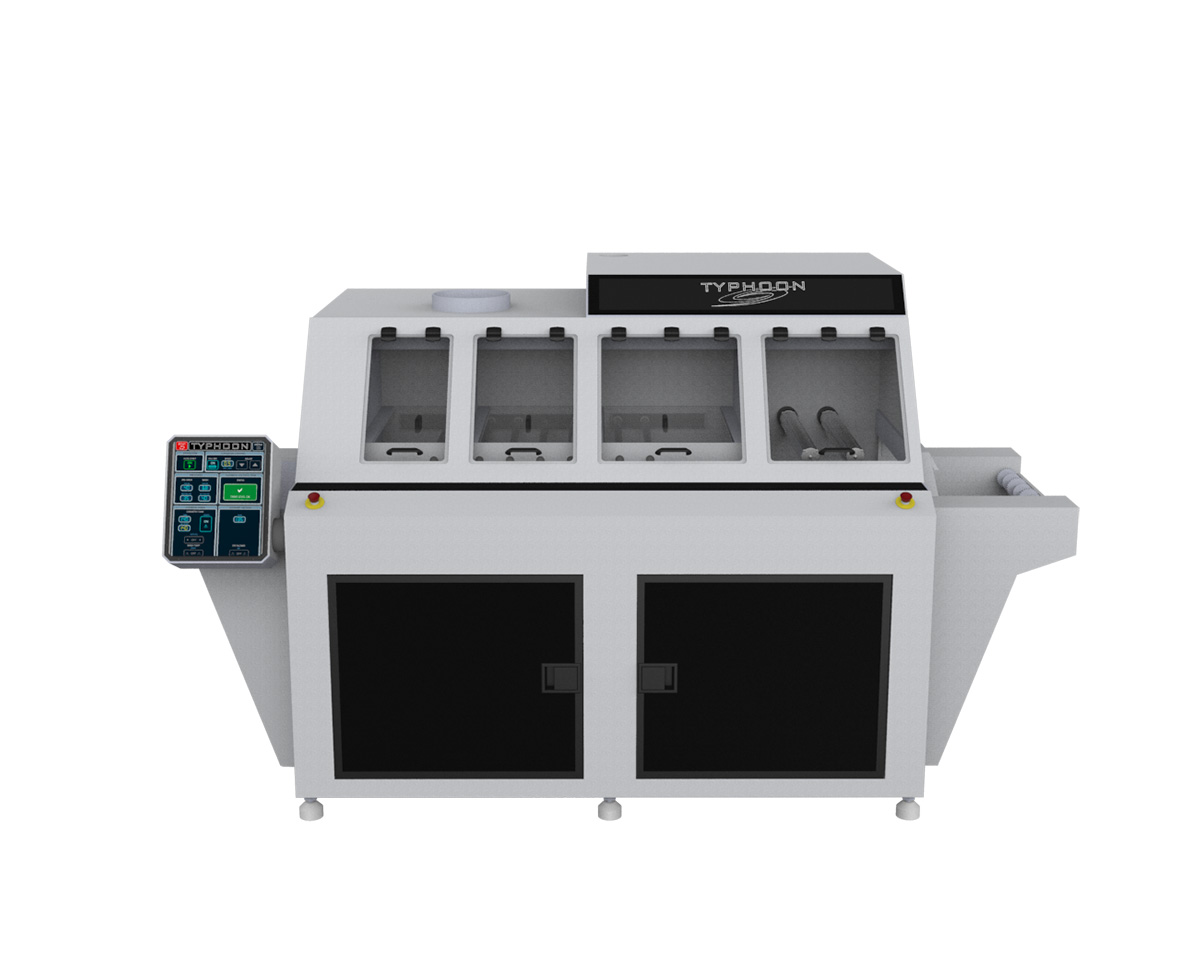
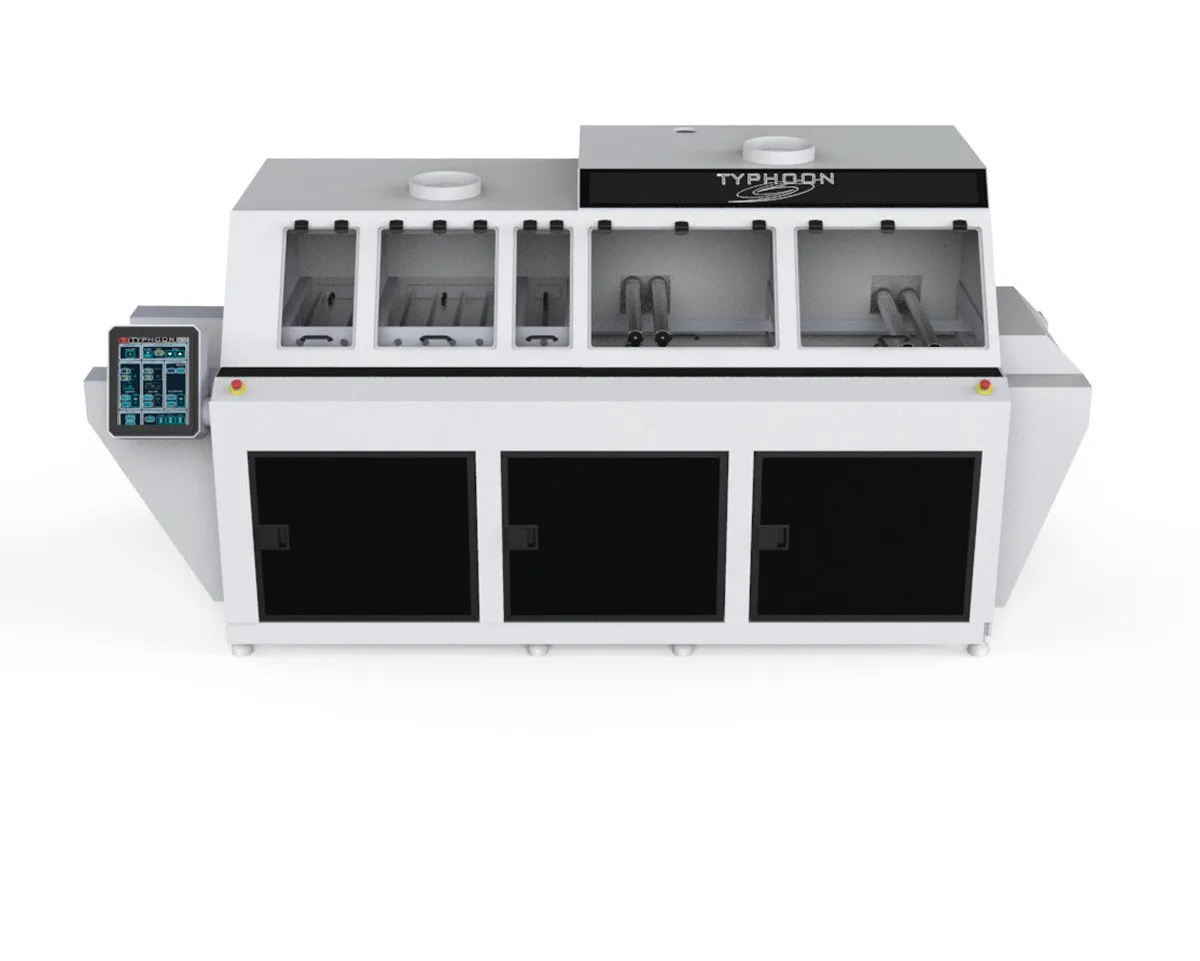
Typhoon T8 Chem Wash/ISO
Chemical module with water-free isolation
Chemical wash/isolation module with dosing control and air blow-off; a separate rinse module is needed to complete the process.
View product online| Technical information | |
|---|---|
| Conveyor belt | 24 in / 60.96 cm |
| Wash pump | 15 HP |
| Maximum listed heated wash | 150 °F / ≈66 °C |
Applications
- Add a chemical wash stage upstream of a separate rinse and dryer.
What leaves the T8 discharge?
The T8 performs a chemical wash and blows off excess solution. Plan a downstream rinse and drying stage before releasing the assembly.
How is wash solution added during production?
AAT specifies automatic chemical dosing. Choose the working concentration with the chemistry supplier and verify it during the trial.
T12 Dual Water Wash/Dry
Dual water wash/dry module
Water wash/rinse/dry module with two drying sections; it can be paired with T8 when chemical washing is required.
View product online- Provide a deionized-water supply for the final rinse. Confirm transfer height and belt speed with AAT before integrating adjacent modules.
| Technical information | |
|---|---|
| Usable belt | 24 in / 60.96 cm |
| Listed total length | 12 ft 3 in / ≈3.73 m |
| Listed electrical supply | 480 V, 80 A, 3Φ |
| Heated wash pump | 15 HP |
| Drying turbine blowers | 2 × 10 HP |
Applications
- Wash, rinse and dry boards in a water process, or rinse boards after a T8 chemical wash.
When would a line use both T8 and T12?
When the residue needs chemical washing, the T8 supplies that stage and the T12 provides water rinsing and drying. For water-washable residues, evaluate the T12 on its own.
How do I check drying on a populated board?
The T12 has two drying sections. Inspect connectors, shields and fixtures for retained water at the intended line speed and loading.
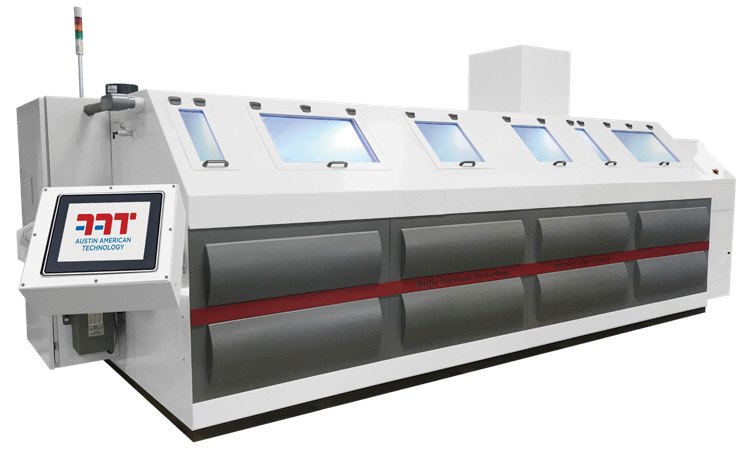
Applications & selection
The represented range covers water-only cleaning, water/chemistry systems and modular chemical washing. A chemical wash module needs a compatible rinse stage; the entire process must be selected around the actual residue and assembly.
Where it fits
- Post-solder flux removal from PCB assemblies
- Cleaning beneath low-profile components
- Conveyor-based production with controlled rinsing and drying
What to consider when selecting
- Provide the flux/paste designation and reflow profile; request a cleaning trial using the most difficult assembly in the product mix.
- Compare usable belt width, component clearances and loading arrangement. Belt speed alone does not establish boards per hour or validated cleanliness.
- Review wash, rinse, exhaust and drying as one installation. Include DI quality monitoring, chemistry carryover and access for filters and maintenance.
Austin American Technology · 02 / 02
DI-water recirculation systems
Treat and reuse process water.
AAT standalone DI recirculation systems use filtration, level control and resistivity monitoring. Size flow, storage and treatment for the connected cleaner; makeup water and maintenance are part of the installation review.
Water
Review recirculation flow and makeup-water demand.
Energy
Evaluate heating and pumping loads for the chosen installation.
Consumables
Define filter and DI-media replacement from water quality and loading.
Applications & selection
Closed-loop DI recirculation treats and returns process water instead of continuously using fresh water. AAT offers standalone systems with filtration, level control and resistivity monitoring; the treatment configuration must match the connected cleaner.
Where it fits
- Rinse-water recirculation for electronics cleaning
- Reducing fresh-water demand and associated heating losses
What to consider when selecting
- Specify required flow, pressure, tank volume and incoming contamination before sizing the recycler.
- Define the required rinse-water quality and alarm response; DI treatment and filtration need an agreed maintenance plan.
- Review maintenance drains and makeup water explicitly. Closed-loop operation does not mean that filters, media or spent chemistry never require replacement.
Common questions
When is MicroJet EC different from HydroJet?
MicroJet EC is documented as water-only with an 18-inch belt. HydroJet uses a 24-inch belt and supports water or chemistry. Confirm residue solubility before choosing.
Does the T8 complete washing and rinsing by itself?
No. AAT identifies T8 as a chemical wash/isolation module requiring a separate modular rinse system. T12 can be paired with T8 for an integrated process.
Does zero discharge include maintenance?
AAT explicitly excludes maintenance from the zero-discharge description for NanoJet. Include maintenance liquids, evaporation makeup and media service when evaluating the installation.
Documentation & references
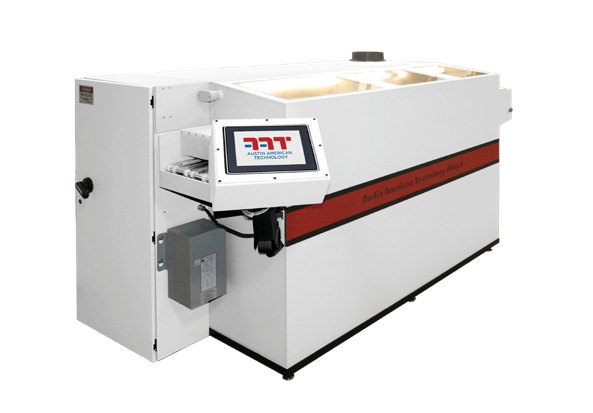
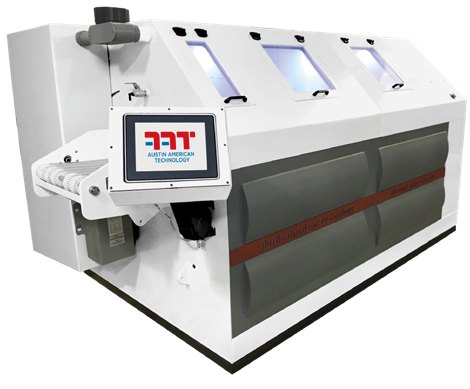
Images illustrate products or families; they do not establish the revision or accessories of quoted equipment. Capabilities and options depend on configuration and process conditions. Confirm requirements with an applications engineer.
- AAT in-line cleaner rangehttps://aat-corp.com/unibody-in-line-cleaners/
- HydroJet technical informationhttps://aat-corp.com/hydrojet/
- MicroJet EC water-only cleanerhttps://aat-corp.com/micro-water-only-2/
- NanoJet process and featureshttps://aat-corp.com/nanojet/
- NanoJet manufacturer datasheethttps://aat-corp.com/wp-content/uploads/2023/09/NanoJet_2022.pdf
- T8 chemical wash/isolation modulehttps://aat-corp.com/t8-chem-wash-module/
- T12 dual water wash/dry modulehttps://aat-corp.com/t12-dual-water-wash-dry-module/
- AAT standalone DI recirculationhttps://aat-corp.com/di-water-generator/